

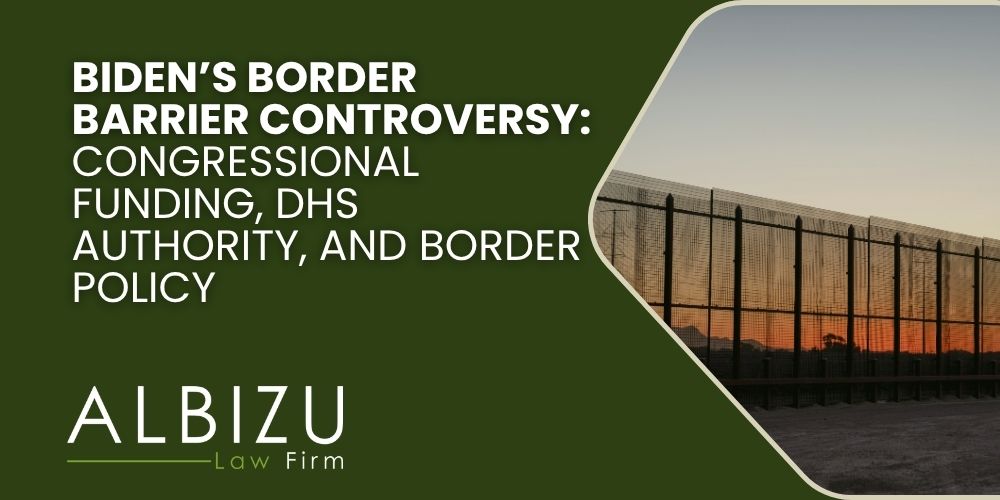
President Joe Biden announced that his administration did not have the legal authority to redirect funds that Congress had previously appropriated for the construction of additional barriers along the southern border. The announcement drew attention because Biden had campaigned on a promise that there would be no additional border wall construction under his administration.
The controversy arose in October 2023 after the federal government authorized additional border barrier construction in Texas.
Federal Government Authorizes Border Barrier Construction
The Department of Homeland Security (DHS) announced plans to construct approximately 20 miles of additional barriers in the Rio Grande Valley area of Texas.
Then-Secretary of Homeland Security Alejandro Mayorkas stated that there was an “acute and immediate need” to construct physical barriers and roads near the international border because of high levels of unlawful entry in the area.
To facilitate construction, DHS waived numerous federal legal requirements involving environmental, historical, and other reviews.
Why Did the Biden Administration Approve the Construction?
Biden maintained that the decision did not represent a reversal of his broader position on border walls.
The funds had been appropriated by Congress in 2019, during the Trump administration, specifically for border barrier construction. Biden said his administration had attempted to have the money redirected but that Congress had not done so.
Because the funds had been appropriated for that particular purpose, the administration argued that it was legally required to use them as Congress directed.
When asked whether he believed a border wall was effective, Biden said no.
DHS similarly emphasized that the administration’s policy regarding border walls had not changed and that the newly authorized construction resulted from its obligation to spend previously appropriated funds.
Increasing Migrant Encounters at the Southern Border
The announcement came during a period of significant migration at the U.S.-Mexico border.
According to U.S. Customs and Border Protection data available at the time, authorities recorded 232,972 encounters along the southwest border in August 2023.
The number of migrants arriving at the southern border had placed considerable political and operational pressure on the Biden administration, as federal, state, and local governments debated how to address migration and border security.
Mexico’s Response
Then-Mexican President Andrés Manuel López Obrador criticized the decision, describing additional border wall construction as a step backward.
López Obrador had consistently argued that physical barriers do not address the underlying causes of migration. Nevertheless, he also acknowledged the domestic political pressure facing Biden in the United States.
Around the same time, López Obrador met in Mexico City with senior U.S. officials, including Secretary of State Antony Blinken and Homeland Security Secretary Alejandro Mayorkas, for high-level discussions involving migration and security.
Political Debate in the United States
The announcement also intensified an already contentious debate over U.S. border policy.
Former President Donald Trump, whose administration had made border wall construction a central immigration policy, responded by arguing that the development vindicated his approach to border security.
Meanwhile, immigrant-rights organizations criticized the decision, arguing that expanding physical barriers could harm migrants and border communities without addressing the underlying factors driving migration.
The controversy also unfolded amid broader disagreements in Congress over federal spending, assistance for Ukraine, and demands from Republican lawmakers for additional measures to strengthen security at the southern border.
Did Biden Reverse His Border Wall Policy?
The administration maintained that it had not adopted a new policy favoring construction of a border wall.
Instead, officials distinguished between supporting border walls as an immigration policy and complying with a congressional appropriation enacted years earlier for a specific construction project.
That distinction was central to the administration’s explanation: Biden continued to oppose a border wall as an effective solution while maintaining that his administration was legally obligated to spend the previously appropriated funds.
An Important Historical Context
It is important to understand this development in its proper timeframe. The events discussed above occurred in 2023 during the Biden administration and should not be presented as a description of current U.S. border policy.
Immigration and border policies can change significantly between administrations and through new legislation, regulations, executive actions, and court decisions. Anyone whose immigration case could be affected by current border or immigration policies should rely on up-to-date information rather than older policy announcements.
If you have questions about your immigration status or options under current U.S. immigration law, contact Albizu Law at 512-861-5638 to schedule a consultation. Our immigration team can evaluate your circumstances and help you understand the legal options that may apply to your case.