


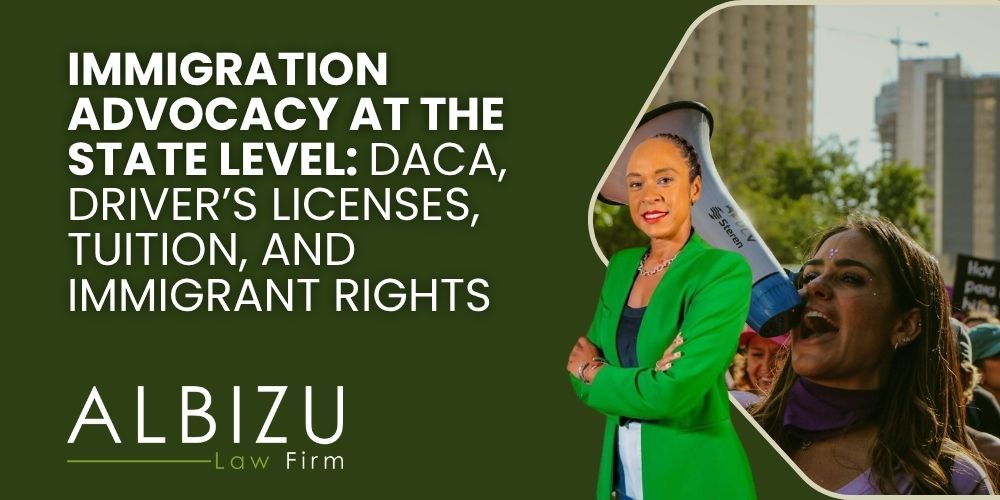
At a time when Congress is deadlocked over federal immigration legislation, some activists have turned to local legislatures to promote and pass bills that would allow undocumented immigrants to obtain driver’s licenses, in-state college tuition, and other services.
“Because Washington isn’t working, because Washington isn’t able to solve problems at the national level, states have been trying to improve people’s lives,” said Juan Manuel Guzmán, director of state advocacy for the immigrant advocacy group United We Dream.
But those local advocates have also recently strengthened their defenses against what several describe as a rise in anti-immigration legislative proposals in Texas and other states ahead of next year’s presidential election.
The last time Congress passed a law providing a pathway to citizenship for a large portion of the undocumented population was nearly 40 years ago. Current efforts to overhaul the nation’s immigration system have stalled amid disagreements over how to handle high levels of migration at the southwestern border.
Federal inaction has left approximately 11 million undocumented immigrants living in the United States, many of whom lack access to key services, such as subsidized healthcare or retirement benefits, as well as a pathway to citizenship.
This has left states to address the situation. Rebecca Shi, executive director of the American Business Immigration Coalition, said advocates in states with undocumented residents are “trying to fill the gap” left by congressional inaction.
“There has to be a solution, and if we can act locally, we will,” Shi said.
Dreamers in Limbo
More than a decade has passed since the Obama administration launched the Deferred Action for Childhood Arrivals program, which provides work permits and protection from deportation to certain undocumented immigrants who came to the country as children, known as “Dreamers.”
The program, which does not provide beneficiaries with a pathway to citizenship, was initially conceived as a temporary measure for hundreds of thousands of undocumented immigrants who grew up in the United States and have no way to regularize their immigration status.
Since then, however, Congress has repeatedly tried and failed to pass a legislative solution for this immigrant population, despite ongoing legal challenges threatening to end the DACA program, which does not cover anyone who entered the country—or was born—after June 2007.
Only the federal government can grant work authorization or protection from deportation, which has led immigrant advocates to push for state policies that support immigrants in other ways.
“The last policy we saw that was a victory for the entire community was obviously DACA, which right now is on life support. And Congress has repeatedly failed to pass a pathway to citizenship,” Guzmán said. “The next battle is in the states.”
The only immigration-related bill Congress has introduced this year focused on one such local initiative in the District of Columbia. The House of Representatives passed a resolution to overturn a District of Columbia law that would allow immigrants to vote in local elections, similar to measures adopted by other cities, but the Senate did not take up the measure.
Notable Progress
State and local measures giving undocumented immigrants greater access to certain benefits have gained momentum. In November, Arizona voters approved a proposition allowing high school students to qualify for in-state tuition regardless of their immigration status.
Massachusetts and Rhode Island have laws taking effect this summer that will allow undocumented immigrants to obtain driver’s licenses. In Massachusetts, the state House voted to override the governor’s veto to advance the legislation.
The COVID-19 pandemic, in particular, accelerated efforts to expand undocumented immigrants’ access to subsidized healthcare.
In 2021, California became the first state to enact a law expanding healthcare access for low-income residents regardless of immigration status. Advocates predict that campaigns will continue to intensify to expand healthcare access for older undocumented immigrants who are ineligible for Social Security and other federal benefits.
According to a December report from the National Immigration Law Center examining state legislative action between 2012 and 2022, at least 23 states now offer in-state college tuition to undocumented students. Eighteen states already offer or will soon offer driver’s licenses to undocumented immigrants, compared with only three states in 2012.
“To the extent that states have the power, or localities have the power, to improve the daily lives of their residents and make sure they feel comfortable interacting with government agencies and receiving what they need, then yes, we have seen remarkable progress at the state and local level,” said Tanya Broder, senior attorney at NILC.
Democratic victories in November in states such as Massachusetts, Vermont, and Maryland could also open the door to advancing measures that assist undocumented immigrants, the NILC report concluded.
Fighting Back
As the Biden administration faces criticism over the high number of migrants crossing the southwestern border, local immigrant advocates are also increasingly being forced to push back against proposals in states such as Florida and Texas that would restrict immigrants’ rights.
A pending Texas bill known as HB 20 would create a state “Border Protection Unit” with the authority to oversee the construction of border barriers and to “arrest, detain, and deter individuals crossing the border illegally.”
Texas officials have blamed the high number of migrants crossing the U.S.-Mexico border on the Biden administration’s immigration policies and have argued that border states have unfairly borne the brunt of the problem.
The Texas Democratic Party has characterized the proposal as a “show me your papers”-style state police measure that would empower officers to detain anyone they suspect of being an undocumented immigrant.
“This atrocious bill, if passed, would do nothing to curb the crisis at our border—it would simply subject South Texans to constant state-mandated racial discrimination and a level of Big Brother police-state dystopia they could not even have imagined,” Texas Democratic Party Chairman Gilberto Hinojosa said in a March 10 press release.
Another bill proposed in the Texas State Senate during this legislative session would prohibit citizens of China, Iran, North Korea, or Russia from purchasing property in the state. The bill does not provide an exemption for U.S. permanent residents or other lawful visa holders.
Texas Governor Greg Abbott, a Republican, has said he would sign the bill if it passed.
Mary Ibarra, policy coordinator for the American Civil Liberties Union of Texas, said there is a “really high probability” that some version of HB 20 will become law.
Florida Republican Governor Ron DeSantis, a likely 2024 presidential candidate, announced sweeping legislation last month that would prevent undocumented immigrants from receiving state-issued identification, invalidate any licenses they may hold from other states, and prohibit undocumented students from receiving in-state tuition rates.
It would also require hospitals to collect information about patients’ immigration status and report the cost of providing care to undocumented immigrants, while increasing criminal penalties for transporting or sheltering undocumented immigrants.
Tessa Petit, co-executive director of the Florida Immigrant Coalition, called DeSantis’ proposal the “worst bill that could pass.” She also said attacks against immigrants have increased in recent years.
“I think this is the first time in Florida’s history that we’ve been attacked this much,” Petit said.
Ibarra described a similar trend in Texas, where Republican Governor Rick Perry signed a law more than 20 years ago allowing undocumented immigrants to qualify for in-state tuition.
Ibarra said anti-immigration proposals have become more frequent since 2016, when Donald Trump was elected president following a campaign that prominently featured anti-immigration rhetoric.
“I think the lack of action, of proactive action, at the federal level has allowed many ideologies to gain momentum,” Ibarra said. “Now it’s become popular for Republican governors to consolidate power, use it as a talking point, and as something they believe will get them more votes.”
Schedule a Consultation Today!
At Albizu Law Firm, we understand the importance of fighting for the rights of immigrants and their families. As a firm specializing in immigration and family law matters in Austin, Texas, we have witnessed the challenges many individuals and communities face due to Congress’s lack of action on federal immigration legislation.
Now more than ever, it is crucial to take action at the local level to promote and pass legislation that benefits undocumented immigrants. If you are interested in supporting this cause and would like to learn more about how you can contribute, share this article with your friends, family, and on social media!
Additionally, if you are facing a complex immigration situation or need legal guidance regarding immigration or family law matters, we invite you to schedule a consultation with our experienced attorneys. We are here to help you navigate the complex legal system and provide the representation you need.
Call 512-861-5638 or visit our website at www.albizulaw.com to schedule your consultation today. We look forward to serving you soon!